
Insights – Is the Stock Market Rational
June 2026
Key Takeaways
- Equity Markets are enjoying a strong year despite the Iranian war and are now up 6% since the war started and 9% this year. This is causing many to ask, “Is the stock market rational?”
- AI remains the biggest theme in equity markets and the recent rise in markets has been driven much by semiconductor stocks, which have risen 45% this year.
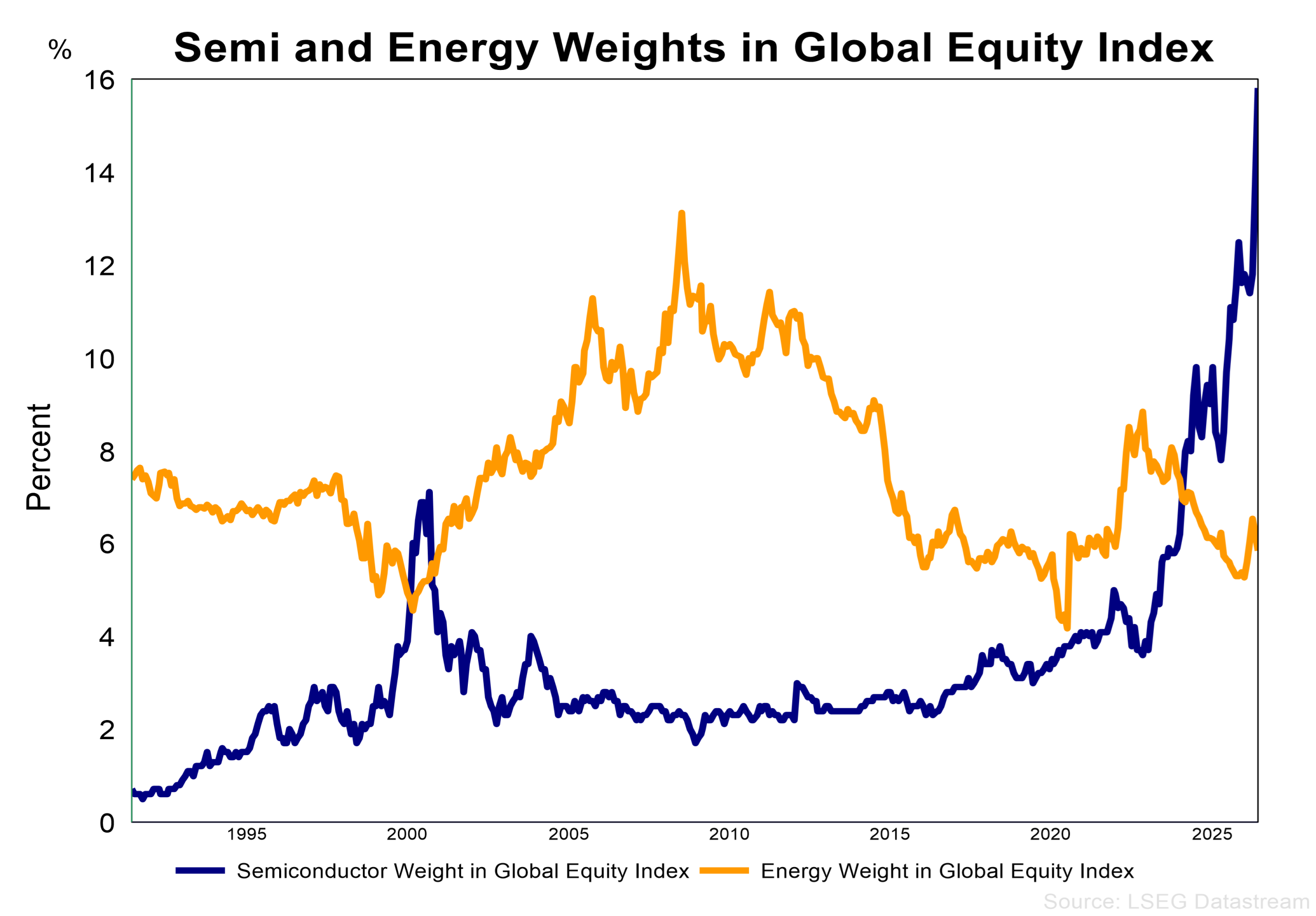
- Semiconductor stocks now comprise 14% of global equity indices, surpassing levels they reached in 1999 and surpassing where the energy sector peaked in 2009.
- Semis aren’t the only cyclical sector rallying this year and the European Energy sector is up 32% as it’s benefiting from a prior period of underinvestment as energy is starting to be viewed as a “scarce asset”.

Is the Stock Market Rational?
The performance of equity markets of late has left many wondering if the stock market is rational and whether it is fully discounting the potential economic impact of rising energy prices. Global equity markets are currently up 6% since the conflict in Iran started and are now up 9% year to date. This is despite an increasingly troubling macro backdrop where the energy price shock is causing central bankers to become more hawkish, and the combination of higher inflation and tighter monetary policy has undoubtedly increased the odds of a recession.

If the stock market was solely a reflection of current underlying economic activity, markets may be weaker. However, other factors drive equity markets and when looking at broad indices it’s important to realise that we have been in a bull market with the dominant theme being Technology and the race for AI. This theme has grown within equity benchmarks and despite daily news headlines focusing on the conflict in the Middle East, equity indices have been driven more by the evolution of this theme more than anything else.
It’s not abnormal that in the latter stages of a bull market for one theme to take over the stock market and that is what we may be witnessing today. The market isn’t ignoring the energy crisis or the change in direction of central bank policy but rather it is saying that the energy shock won’t be bad enough to derail the AI boom and the expectation is that it is accelerating and whilst consumer and industrial sectors maybe impacted by the war, the AI theme will not, and therefore it has rerated some AI names, particularly semiconductors recently.
The recent parabolic move in semiconductor stocks has pushed the sector to over 14% of the Global Equity market, well above where it peaked out in 1999. This surpasses the 9% it reached amid the TMT driven market of the late 1990’s and the 13% energy reached amid the resource driven market of the 2000’s. Only time will tell if this is rational.
Santiago View
The strength in AI capex today is real and recent earnings announcements from the US Hyperscaler’s confirmed their intentions to keep spending as they are seeing continued demand. This spending is driving the earnings and the share prices of the semiconductor companies. However, there is a risk of focusing on current earnings when accessing companies that operate in cyclical sectors.
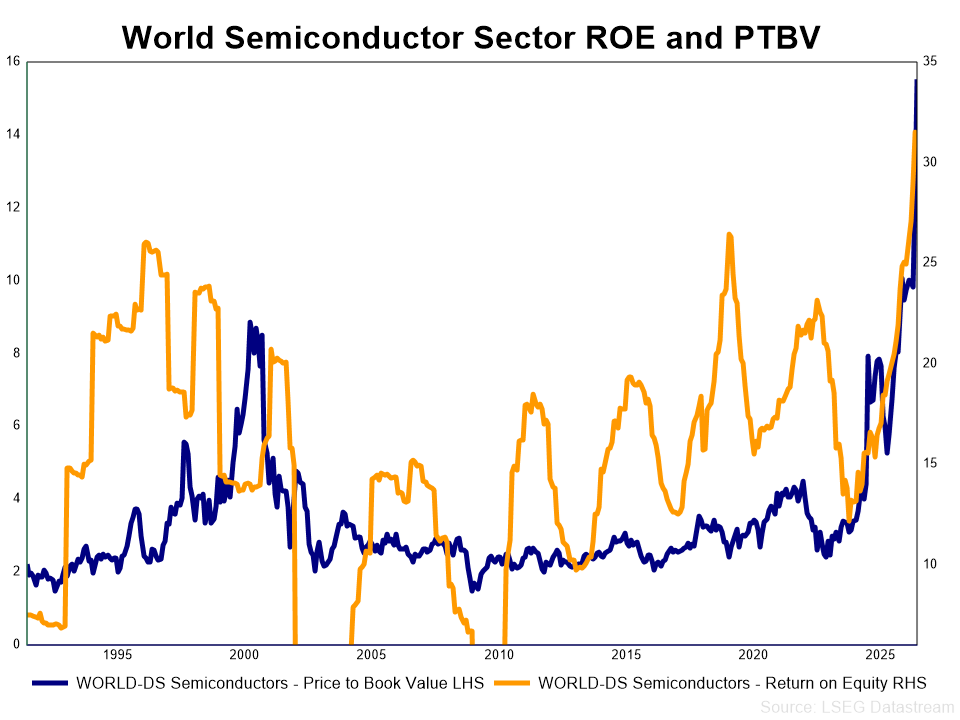
The decision investors face today regarding semiconductor stocks is whether they believe the abnormal returns the sector is generating today are sustainable or if they’ll come under pressure either from a demand shock or a supply side response. It’s difficult to ascertain the level of demand that will eventually emerge from AI but it’s a certainty that supply will be added as semiconductor companies today are accelerating their capital expenditure. The time it will take for supply and demand to come back into sync will dictate the evolution of the semiconductor stocks share prices. With the sector currently trading on a price to book multiple of 14 and generating a return on equity of 30%, it appears that the market is pricing in an assumption that the supply demand imbalance in the industry is not set to come back into equilibrium any time soon.
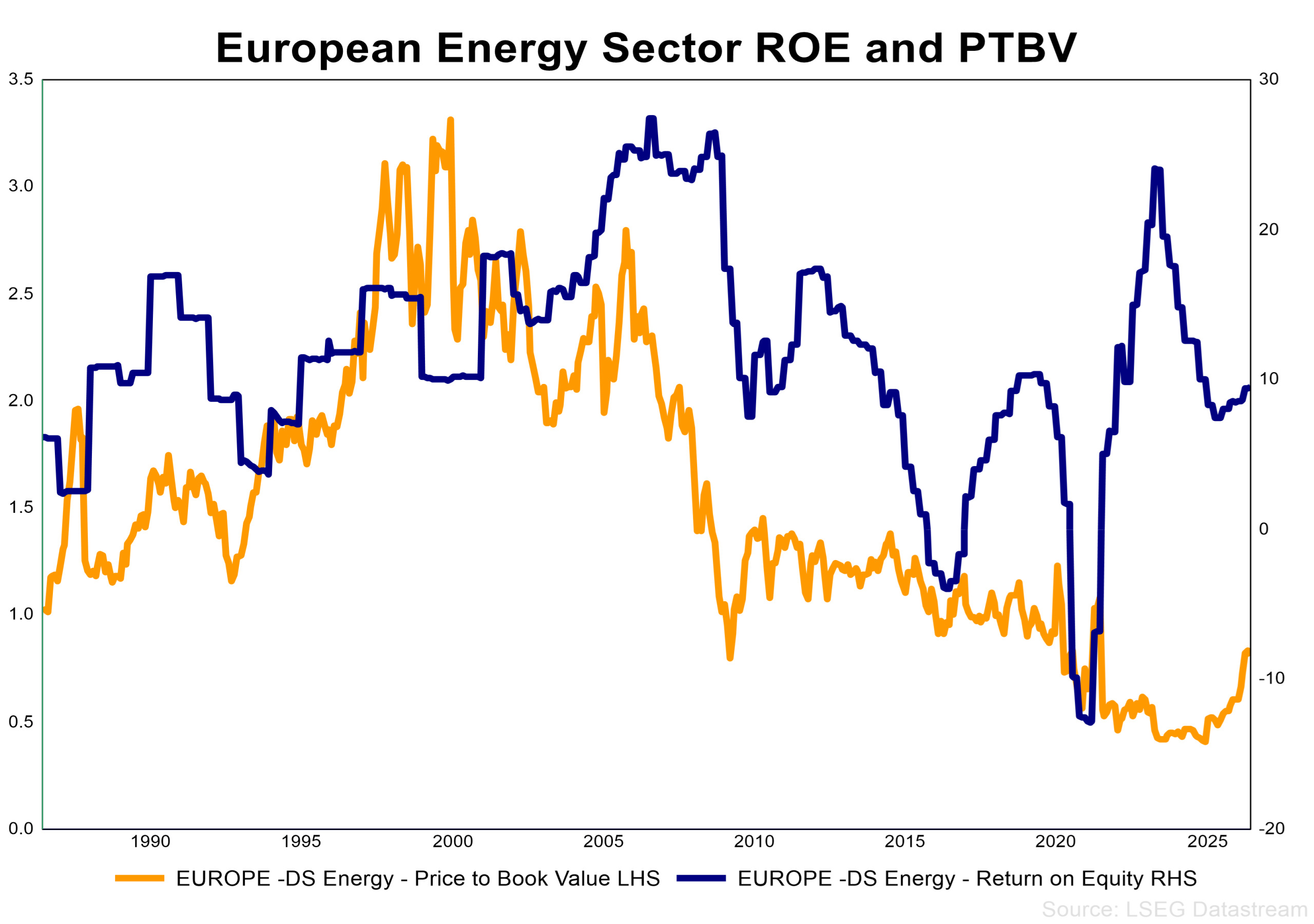
The semiconductor sector is not the only cyclical sector performing this year. The energy sector as well as the mining sector that were starved of capital for a prolonged period are now finding they possess “scare assets” and are enjoying strong cash flows and improving returns on capital as demand picks up. The European energy sector is up 32% this year and whilst the tightness in the oil market has been the catalyst, it highlights the attractiveness of investing in lowly valued cyclical sectors that have been supply constraint.
Spotlight – European Energy Sector
Trading Below Book Value despite improving Fundamentals
- Earnings and free cash flow are accelerating as the benefits of higher commodity prices flow through.
- Capital discipline remains as the sector continues to prioritise cash distributions to shareholders over capital investment. The sector currently offers a 5% dividend yield with buybacks contributing another 3% to shareholder returns.
- Valuations remain attractive with the sector trading below book value despite being up 34% this year.
Conclusion
Conclusion
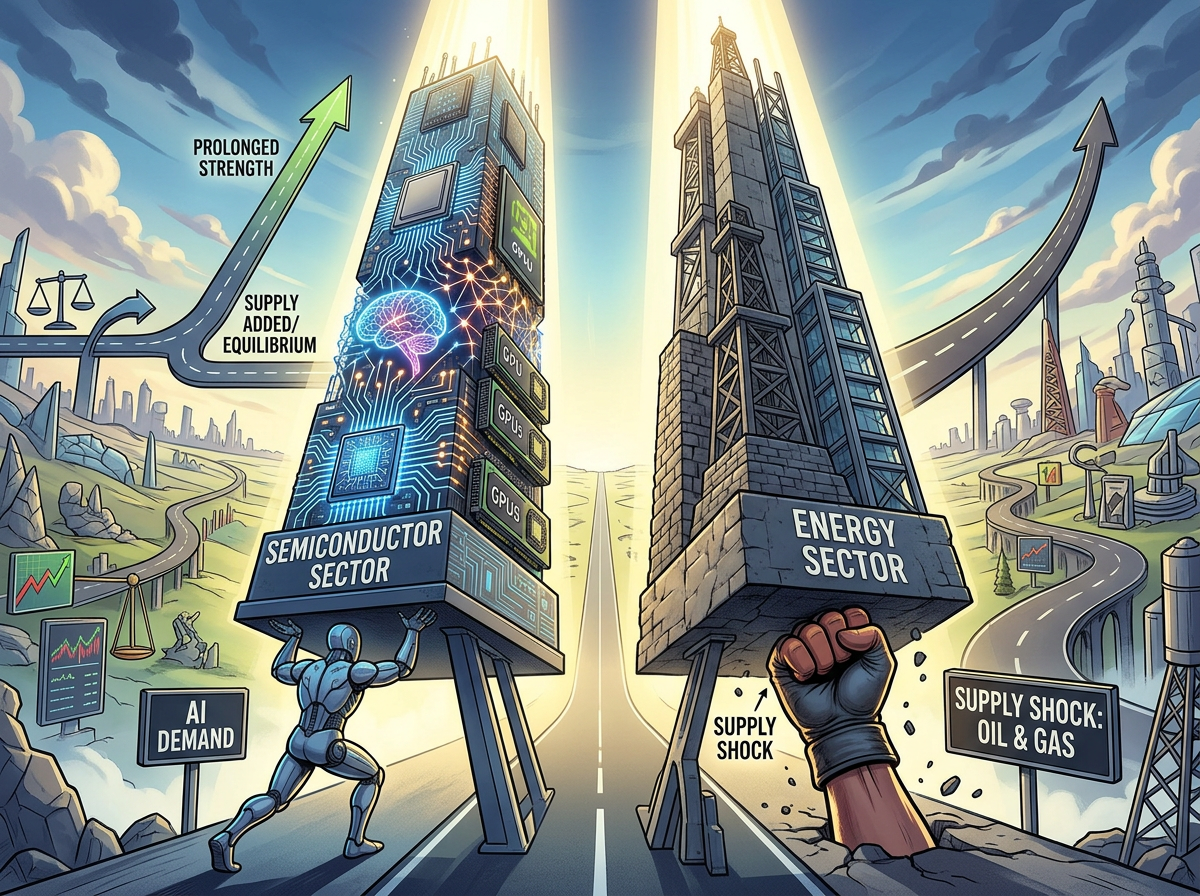
Semiconductors and Energy have been the standout bright spots within the equity market this year and whilst they are both cyclical sectors, they are benefiting from different drivers. Semis, from a new driver of demand in the form of AI and Energy, from a supply shock which has highlighted the scarcity value of oil and gas. The evolution of the cycles driving these sectors will be fascinating to watch. Within the semi cycle, are we set to for a prolonged period of strength as demand outstrips supply as the market seems to expect or will equilibrium be restored as supply is added or demand falls short. Within the energy sector it will be fascinating to see if the combination of a higher oil price environment coupled with a recognition of the importance of oil and gas assets results in the sector rerating from its current levels.
Disclaimer
The information in this article is not a recommendation or investment research. It does not purport to be financial advice and does not take into account the investment objectives, knowledge and experience or financial situation of any particular person. This article has been produced and issued by Santiago Investments. It does not purport to be comprehensive. It is strictly for information and discussion purposes only
| Warning: The value of your investment may go down as well as up. You may get back less than you invest. |
| Warning: Past performance is not a reliable guide to future performance. |